- Regarding Stanford specifically, I did not see the number broken down by academic or residential disability (in the underlying Atlantic article). This is relevant, because
> Some students get approved for housing accommodations, including single rooms and emotional-support animals.
buries the lede, at least for Stanford. It is incredibly commonplace for students to "get an OAE" (Office of Accessible Education) exclusively to get a single room. Moreover, residential accommodations allow you to be placed in housing prior to the general population and thus grant larger (& better) housing selection.
I would not be surprised if a majority of the cited Stanford accommodations were not used for test taking but instead used exclusively for housing (there are different processes internally for each).
edit: there is even a practice of "stacking" where certain disabilities are used to strategically reduce the subset of dorms in which you can live, to the point where the only intersection between your requirements is a comfy single, forcing Admin to put you there. It is well known, for example, that a particularly popular dorm is the nearest to the campus clinic. If you can get an accommodation requiring proximity to the clinic, you have narrowed your choices to that dorm or another. One more accommodation and you are guaranteed the good dorm.
- I think there's a non-malicious explanation for a percentage of this.
As I grew up in the 80s, there were two kinds of gifted kids in school: The kind that would ace everything anyway, and the kind that, for a variety of reasons, lacked the regulation abilities to manage the school setting well, with the slow classes and such. A lot of very smart people just failed academically, because the system didn't work for them. Some of those improved their executive function enough as they went past their teenage years, and are now making a lot of money in difficult fields.
So what happens when we do make accomodations to them? That their peaky, gifted performance comes out, they don't get ejected by the school systems anywhere near as often as they were before, and now end up in top institutions. Because they really are both very smart and disabled at the same time.
you can even see this in tech workplaces: The percentages of workers that are neurodivergent is much higher than usual, but it's not as if tech hires them out of compassion, but because there's a big cadre or neurodivergent people that are just in the line where they are very productive workers anyway. So it should be no surprise that in instutitutions searching for performance, the number of people that qualify for affordances for certain mental disabilities just goes way up.
That's not to say that there cannot be people that are just cheating, but it doesn't take much time in a class with gifted kids to realize that no, it's not just cheating. You can find someone, say, suffering in a dialectic-centric english class, where just following the conversation is a problem, while they are outright bored with the highest difficulty technical AP classes available, because they find them very easy.
by OGEnthusiast
15 subcomments
- American society is at the point where if you don't play these sort of games/tricks, you'll get out-competed by those who do. Bleak.
- I don't know about Stanford students' actual disability, so I can't say much to that. I went to shitty high school and decent middle school in relatively poor middle class neighborhood. Now, I live in a wealthy school district. The way parents in the two different neighborhood treat "learning disability" is mind blowing.
In my current school district, IEP (Individual Education Program) is assigned to students that need help, and parents are actively and explicitly ask for it, even if the kids are borderline. Please note that, this doesn't take away resource for regular kids, in fact, classrooms with IEP student get more teachers so everyone in that class benefits. IEP students are also assigned to regular classroom so they are not treated differently and their identities aren't top secret. Mind you, the parents here can easily afford additional help if needed.
In other neighborhood, a long time family friend with two young children, the older one doesn't talk in school, period. Their speech is clearly behind. The parents refuse to have the kids assign IEP and insist that as long as the child is not disruptive, there is no reason to do so. Why the parents don't want to get help, because they feel the older child will get labelled and bullied and treated differently. The older child hates school and they are only in kindergarten. Teachers don't know what to do with the child.
by windows_hater_7
3 subcomments
- I go to one of those elite universities now, and I get academic accommodations. I think some of the increase is truly from greater awareness about disabilities among teachers and parents. My mom was a teacher, and she was the one who first suspected that I had dyslexia. I repeated kindergarten, and I was privileged that my parents were able to afford external educational psychology testing. Socioeconomic status is a large part of my success. Even seemingly small things like the fact that my parents could pick me up after school so that I could go to tutoring was something that other kids didn’t have, because their parents were working or didn’t have a car.
- New York Times had an interesting podcast recently where they talked about how so many children are being diagnosed with autism to the point where it's hurting the severely autistic student population (https://www.nytimes.com/2025/11/24/podcasts/the-daily/autism...). There's a finite set of resources pooled for special needs students, and now most of these students have relatively minor symptoms compared to those with "profound autism" (which is a severe disability associated with the inability to speak or live independently).
I suspect this is similar - rich parents are doing anything for an edge in their child's education and can get any diagnosis they desire. It's an unfair system.
- I'm mostly a law professor these days. When final-exam time rolls around (as in, this week), I raise my eyebrows when I'm sent the list of students who get 50% extra time. I wouldn't presume to judge the propriety of any given student's accommodation. But many of the accommodated students seem to have done just fine in class discussions during the semester.
FTA: "Unnecessary accommodations are a two-front form of cheating—they give you an unjust leg-up on your fellow students, but they also allow you to cheat yourself out of genuine intellectual growth."
by mikkupikku
0 subcomment
- This sort of scamming has been going on for a long time, by rich kids particularly. I remember 20 years ago I was surprised to learn that one of my friends, a very clever guy from a very well off family, was supposedly so profoundly disabled that he could do all of his tests overnight and at home. When I asked him how he got such a sweet deal, the answer was "My dad's a doctor."
by pavel_lishin
8 subcomments
- > the current language of the Americans with Disabilities Act (ADA) allows students to get expansive accommodations with little more than a doctor's note.
Isn't that... good? What else would be expected if you have a disability, and need accomodations?
- > "It's just not. It's rich kids getting extra time on tests." Talented students get to college, start struggling, and run for a diagnosis to avoid bad grades.
Okay, I was an undergrad at Stanford a decade ago, I graduated with two majors (math, physics) and almost another minor (CS) so I took more credits than most and sat in more tests than most, and I don’t think I’ve seen a single person given extra time on tests; and some of the courses had more than a hundred people in them, with test takers almost filling the auditorium in Hewlett Teaching Center if memory serves. Article says the stat “has grown at a breathtaking pace” “over the past decade and half” and uses “at UC Berkeley, it has nearly quintupled over the past 15 years” as a shocking example, so I would assume the stat was at least ~10% at Stanford a decade ago. So where were these people during my time? Only in humanities? Anyone got first hand experience?
by powerclue
4 subcomments
- That doesn't seem outrageously high for a high cap school?
15-20% of the world is estimated to have a disability. So Stanford population is high, but approximately double the average of a random global population sample.
Now, think about the selection pressures Stanford applies. Stanford selects students who are fighting for top academic honors. Those students are dealing with brutal competition, and likely see their future as hanging on their ability to secure one of a small number of slots in the school. Anxiety would be genuinely higher in the student body than, say, students at a mid rate state school.
Stanford wants students with strong test scores, especially those who are strongly capable in mathematics. High spatial awareness, cognitive integration, and working memory can be positive traits in some autistic people and some find strong success in standardized environments and in mathematics.
We're also improving diagnostic tools for autism and ADHD, and recognizing that the tools we used missed a lot of cases in young women, because they present differently than for young men.
Imagine a house party where the guests are selected at random from MIT or Stanford, then imagine you selected guests at random from, say, all Americans. Are you telling me you'd be surprised if the MIT and Stanford crowd had a noticeably different population demographic than the overall American population?
- If 38% of the top 1% of students have learning disabilities then I'd expect students near the mean to be 100% learning disabled, if those words have any meaning left.
- > The students at America's elite universities are supposed to be the smartest, most promising young people in the country. And yet, shocking percentages of them are claiming academic accommodations designed for students with learning disabilities.
What the actual... Lack of journalistic integrity rears its head once again. Executive function and social challenges do not make a person "not smart."
Going back to the core of the problem, I feel that this does need to be controlled. It's one thing to disability signal online to gain clout, it's a completely different thing to drain resources from genuinely disabled folks. Disabilities need to come with diagnoses.
by dev_l1x_be
0 subcomment
- It is a pattern. If you make it beneficial to declare some status (there is a fine distinction between conditions that a person was born with vs just declaring something) more people are going to declare that. This happened in my country when we introduced preferential treatment for certain minorities and there was a huge uptick in people declaring being part of that minority group. This was for claiming a university benefit.
by windows_hater_7
0 subcomment
- Does this number include housing accommodations? They are provided through the same disability office. I have dry eye disease, and when the relative humidity was 19% in my dorm room I requested an accommodation to have a humidifier. I’m sure that type of accommodation wouldn’t have been approved in the past.
- The fact that this shows higher numbers than the community college kids ("...have far lower rates of disabled students...") is interesting too. Yeah, one can argue that Stanford maybe is just so accommodating that it just serves as a great attractor for people with disability. I somehow doubt that.
I wouldn't be surprised that this is part of some coaching program too. It seems too random for folks to just "stumble" on a hack. There are few of these outfits which advertise that they can "get your kid accepted into colleges" if you buy their services.
> But the current language of the Americans with Disabilities Act (ADA) allows students to get expansive accommodations with little more than a doctor's note.
If we take honesty out of the equation, what's the downside for not declaring a disability, if it's not that hard to get a note from a doctor? You get better housing, and more time on tests. I am surprised the number is not higher, actually like 75% or something.
- I went to an elite school. I had undiagnosed depression and ADHD and I almost failed out.
I don't think I needed more time on tests but I definitely needed medication and counseling. The counseling resources available at the time were not adequate and medication was difficult to get.
by weehobbes
2 subcomments
- I have a teenager who is at an academically rigorous college prep school. He is incredibly bright and one of the best students in the school. But he has an accommodation in math for extra time because he has a form of dyscalculia which makes him very prone to misreading and mixing up in working memory the numbers, symbols and other formulas. He understands all the concepts well, but his disability results in calculation/mechanical errors unless he has the extra time to check his work multiple times for these errors. I believe this kind of disability and accommodation is legitimate, but I understand why others may disagree. He even says he often feels guilty for getting extra time when others don't. I am sure there are also people who abuse the system and get accommodations when then don't actually need them.
by TuringNYC
3 subcomments
- I had neither healthcare coverage in high school nor expensive college consultants. When I got to college (Cornell) all my friends told me they had plenty of extra time on the standardized exam (the SAT) by virtue of doctors letters declaring conditions requiring accommodations. I'm sure some of these were legitimate. But practically everyone I spoke to supposedly had ADHD and resulting accommodations on the SAT. I'm not a MPH or Epidemiologist, but does 80% or 90% of the student population truly have a condition requiring accommodations?
Once 10 or 20% of students are doing this, it isnt unexpected for everyone to start doing it just to get on an even playing field. As usual, the poor students lose out because they cannot afford the doctors or expediters who can facilitate all these things.
- This focuses on students seeking diagnoses. But I would expect most of them have already been diagnosed long before college. Parents with high expectations of their children are more likely to seek diagnoses. If you've spent your childhood being told you are ADHD and on Ritalin, then it is natural you would self-identify as such in college.
- > one professor told Horowitch. "It's just not. It's rich kids getting extra time on tests."
This is a blunt quote, but it gets at a key part of the problem: Qualifying as having a disability can come with some material benefits in many schools.
The intentions are good: Schools are doing what they think is best to accommodate and help students with disabilities. It has been a high priority for decades. However, some of these accommodations come with academic advantages. Extra time on tests is the most common one I've seen.
Combine this with the ease of qualifying for a disability (look up the right doctor online, schedule an appointment, pay insurance copay, walk out with a note) and it became an easy, cheap, and tangible academic advantage.
One of the schools I'm familiar with switched to giving everyone the same, longer time period for taking test because it was becoming obvious that the system was being abused.
by seizethecheese
1 subcomments
- There was a kid in my high school physics class who went to Stanford. One time, someone broke the curve on the midterm test, making it hard for most students to get an A. The future Stanford student’s mom visited the teacher to beg for extra credit assignments. He got his A.
I suspect Stanford selects for students who are smart, yes, but most exceptional at gaming the system. Perhaps this is a natural consequence of watering down the difficulty of classes and standardized tests.
by apexalpha
1 subcomments
- My father is a super stubborn Dutch guy. Needs to see proof of something 10 times before he changes a long held believe.
Long time ago something came up like this in the Netherlands. Some massive, unexplained increase in disability.
I asked how could this ever be possible?
He asked: "Are any of the disabilities that show a massive increase not objectively measurable but still eligible for subsidies?
At the time I thought it was such a backwards way of thinking but over the years I can't shake this sentence.
- Whether I care depends on the accommodation they're seeking.
When I was in school, the department that dealt with accessibility could chop the spine off a book, scan it and give you a high quality ebook. I also knew someone who was flagrantly cheating with some test-taking accommodation.
That ebook service was just a nice thing that more people should have taken advantage of. One or two of the professors even subtly encouraged using it to pirate textbooks.
- This is super common in affluent school districts. Bulldozer parents with lots of time and resources eventually get their kid some diagnosis that confers benefits in their schooling. Be it additional time on assignments, one on one tutoring, or whatever. They carry these diagnoses, habits, and expectations to college.
To be clear I am not making light of or dismissing legitimate issues. Simply pointing out that there are some that take advantage of the systems that exist.
You actually are starting to see this in the corporate world. People with a laundry list of diagnoses and other statuses that make them very tricky to let go for performance reasons.
- The amount of pressure young kids are under... I am surprised the numbers aren't much higher. I grew up with debilitating OCD/Tourettes. I am glad kids growing up today have more resources than I did. Society itself is sick and broken. If that many kids are having issues.. Maybe the system is the problem here?
- People respond to incentives. Give disabled people advantages and you get more disabled people.
by whalesalad
1 subcomments
- It's like when all the prisoners in Orange is the new Black start to claim they are Jewish in order to get the nicer Kosher meals from the cafeteria.
- Reading the comments here people seem to care more about what is "good" for the individual than what is good for the institution.
If you have learning disability that requires "assistance" at an elite university, then why can't I play in the NBA with stilts while being allowed to double dribble and travel?
Sure would be awesome for me to play in the NBA! Probably wouldn't be good for the NBA though.
- I just had an edifying conversation with a recent Standford grad who was a TA, and she talked about how some huge percentage of the class has testing accommodations that allowed them to take all exams in a private room, with no supervision, and with access to their phones (and the internet).
And the professors and TAs were not even allowed to ask the students what they needed those accommodations for.
- It is interesting how accommodations can reveal dysfunctions in educational practice. In my courses, requests for accommodations generally change the course design for all students. This is because the accommodation does not alter expected learning outcomes, but it is clearly something that aids students with difficulty learning the material succeed. My goal is that all students succeed in the expected learning outcomes. I don't want the course to be challenging for the wrong reasons. So often the request reveals something I was doing that is unnecessary and makes the class more difficult for little reason. That isn't to say that there are not learning environment that should add additional stress. Sometimes such conditioning is needed so that one can succeed in the challenges they are being trained for. That isn't the case for my students.
- Timed tests encourage wrote memorization and reflexive knowledge. They don't encourage what is reflective of the modern real world knowledge recollection. In almost all scenarios, you have a book to reference for knowledge, much less search engines (and now LLMs). Almost nothing is memorized today, in the work world. What you know, in my experience, comes from frequent usage. Your timespan to work on most things is on the order of days, not minutes or an hour.
Tests should be open book, open notes, and an extensive amount of time to do the test. The questions should be such that they demonstrate an understanding of the material, not just how well you can parrot back information.
Whilst I would love tests to be open internet, this lends itself to very easy cheating. The material being taught and what notes you take about it should be enough to answer any questions posed to you about the material. Especially those that demonstrate an understanding of the material.
by ChrisArchitect
0 subcomment
- Related:
Accommodation Nation: America's colleges have an extra-time-on-tests problem
https://news.ycombinator.com/item?id=46121559
- With rates that high, it's a disadvantage if you don't have specialists assess your kid for all the things that could qualify them for extra testing time if you have the money to do it.
- A few scattered comments, no single argument...
Performance-doping by a large percentage of students at prestigious schools has been going on for decades. Separate from the people who are wired differently and really need the chemical tuning.
Also, it seems a lot of students are on anti-depressants. (You might be, too, if you had pushy overachiever helicopter parents always pushing you. Or if the same career that paid for your affluent upbringing, including college admission advantages, came because a parent operated very selfishly in general.)
Meds seem to be a go-to solution for many affluent families.
Adderall doesn't let someone be the brightest student, but it helps them keep up with courseload, of study-heavy or lab-heavy classes -- to compete with the students who have better/more prior education/experience, better work practices, who prioritize studies over partying, or who are otherwise brighter as a student in some regard.
Of the students who didn't actually have an ADHD disability, but ended up relying on the meds anyway, they aren't bad people. They're actually generally nice and smart, like everyone else. I hope it keeps working for them, or they are able to wean off without ill effects.
One thing I really worry about is a different but related problem: a culture of cheating, most recently accelated by ChatGPT and the like. That seems to be having really bad societal effects already.
One thing I wonder about is whether some of the students on other meds, like for depression, are having too much edge of passion and creativity taken off. Although the college admissions and career prep books and coaches tell students how to give the corporate-standard performative indicators of "passion", that comes out as a very different thing, and maybe all the meds has something to do with that. (I suppose a professor who's been engaged for a few decades would have a good perspective on this.)
by hollerith
2 subcomments
- >the current language of the Americans with Disabilities Act (ADA) allows students to get expansive accommodations with little more than a doctor's note.
Stanford can make the student pay any costs of the accommodation if Stanford wants to push back on the student. E.g., if the student requests extra time on tests, Stanford can estimate the total cost of employing the proctor and bill that (amortized of course over the amount of extra time).
But yeah, it is kind of excessive how much special treatment a person can get in US society just by being rich enough to afford a doctor who will sign whatever letters the person needs (and being shameless enough to request the letters). Another example is apartment buildings with a strict policy of no dogs. With a doctor's letter, the pet dog becomes a medically-necessary emotional-support animal, which the landlord must allow per the same ADA discussed in the OP.
by kazinator
3 subcomments
- For pete's sake just give everyone extra time on tests; what's the big deal?
If you know the stuff, regurgitating it faster is a trivial optimization.
by al_borland
0 subcomment
- I got ok grades in high school with 0 effort. When I got to college, that changed drastically, as I never learned how to actually study or learn on my own. I was on academic probation after my first year and had to figure out how to study, since I never had to do it before. I never could figure out how some of my roommates could study for hours at a time each week, I didn’t really know what they were doing. One class let us make a 1 page cheat sheet for the exam, that was pretty effective for me; once I made it, I didn’t need it. So the night before an exam I would do that, even if I couldn’t use it. That seemed to be enough to get me off of academic probation and graduate in 4 years with a semi decent GPA… but that was also after switching to the business college, which was much less effort than engineering. The worst were 2 self-instructional classes I had. I forgot about them both completely. I did one of them in the last 48 hours of the semester and took 6 exams in one day.
Fast-forward 20+ years and I find out I have ASD and ADHD. Knowing may have helped give me some better ideas for strategies, but part of me is glad I didn’t know, because I didn’t have an excuse and found a way through. Though I’m not sure any of the accommodations I hear about would have been helpful. I never needed more time during tests and having to take care of an animal just sounds like more on my plate. Had I actually spent time with tutors to study, I likely would have burned out. I needed a lot of downtime away from people.
I can totally believe that some kids who excelled in high school, enough to get into Stanford, would fall apart in college without the same structure and would need some assistance. But I do question what that will do for them when they need to go out and get a job. I know companies are supposed to provide accommodations if needed, but I have to believe that will impact their career. I haven’t told my manager or anyone since I found out about my own issues. It used to not be a problem at all, as my old manager let me work my way and he may have even known before I did, he was good at picking all kinds of things out like that. Currently I’m struggling for the past 4 years or so, but I’m not sure what to do about it.
- Amongst groups for extremely gifted kids I’ve seen, well over half are neurodivergent. It’s a well understood issue in gifted kids psychology. When these kids are accommodated appropriately they ace their classes, and when not, they fail out entirely, even at the most basic levels of education.
So the statistics mentioned in the article are not necessarily inconsistent with what we’d expect, since Stanford is a highly selective school that’s by definition going to be picking gifted kids over less gifted ones, and from that group will pick those that were accommodated appropriately.
(There could also be cheating - I don’t know either way. I’m just commenting on the premise of the article. One person in it claims the kids aren’t really disabled because they don’t have wheelchairs. Hopefully it’s fairly obvious that this claim is totally illogical. Such an obviously unreasonable claim on a website called “Reason” makes me wonder what they are actually trying to achieve there.)
- I had a friend in high school who was able to take untimed tests. I later heard a teacher griping, because they didn't think my friend needed them. (I agree.)
My friend had a very good life, until he took a job that really clashed with his, uhm, tendency to be a perfectionist. When we caught up (because we hadn't spoken in a few years,) it was clear he didn't have much insight into how his perfectionism worked against him in the job. (It was a job where quantity was more important than perfection.)
What would have helped my friend more? Not the diagnosis that he needed untimed tests. Instead, counseling where he understood his difference, how to make best use of it, and when he needed to let go and not be a perfectionist.
by thatfrenchguy
0 subcomment
- > The result is a deeply distorted view of "normal." If ever struggling to focus or experiencing boredom is a sign you have ADHD
> risk-aversion endemic in the striving children of the upper middle class
OP has likely never had a kid with ADHD (I get it, they're like 24), getting a kid to be ADHD diagnosed is neither fun nor something you would do lightly in the US.
Which is also why older millennials would just not get diagnosed and just struggle more. Tech is full high functioning people with ADHD and autism, it's not surprising you'd see so many students at Stanford being the same.
- I used to teach in a UK university and encountered many American students on exchange. It was almost their standard policy to claim disability when something did not go their way.
- > Most of these students are claiming mental health conditions and learning disabilities, like anxiety, depression, and ADHD. ... Obviously, something is off here. The idea that some of the most elite, selective universities in America—schools that require 99th percentile SATs and sterling essays—would be educating large numbers of genuinely learning disabled students is clearly bogus.
"Obviously"? "is clearly bogus?"
Not to me. I see too much rhetoric and assumptions. In an article in Reason magazine, I expect more -- to demonstrate careful thinking that cuts through lazy common-sense thinking.
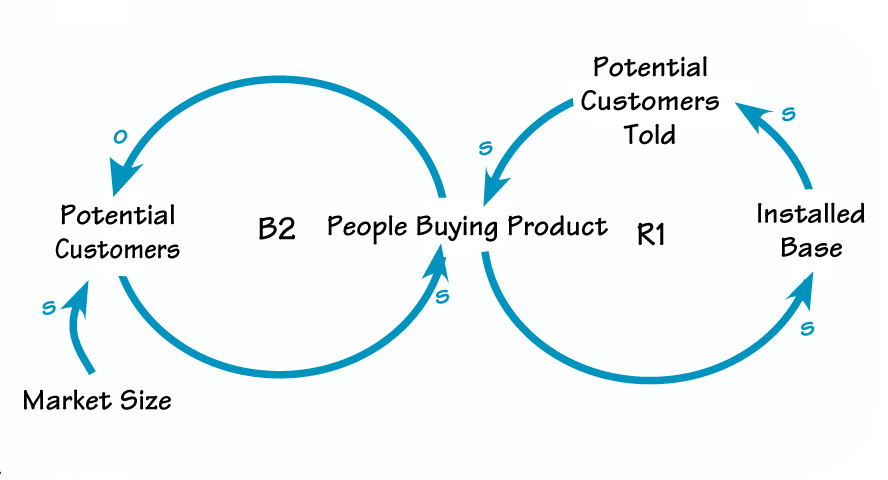
To make sense of a situation, one of my favorite tools is simple: a causal diagram(s). See [1]. This requires effort, and it should. Making a useful, communicable model that forms the foundation for your argument takes practice. Here's a disability-related example: [2]
I want to live in a world where causal models are demanded by readers.
[1]: https://thesystemsthinker.com/wp-content/uploads/images/volu...
[2]: https://ibb.co/5XcGyLK0
by guizadillas
2 subcomments
- It's funny how upset most comments are with the realization that a lot more people are disabled while most of the users in HN are probably on the spectrum
- There's a GAO report from last year about the dramatic increase of students with disabilities in college.
In 2004/2008/2012, 11% of college students had disabilities. It was 21% in 2020.
In 2020, 69% of students with disabilities had behavioral or emotional conditions - up from 33% in 2004.
https://www.gao.gov/assets/gao-24-105614.pdf
- The whole thrust of the article is complaining about timed tests and some kids getting more time. That's doubtless unfair if some are overclaiming, but the real solution is to not do timed tests at all - they are only serving to produce an arbitrary bell curve so that some can have higher grades and get better career opportunities. Better to not have a timer at all, and let people's actual ability shine.
by readthenotes1
0 subcomment
- "Show me the incentive and I'll show you the behavior"
- Charlie Munger
Better rooms, more time on tests, sympathy, and more....
- My wife has a cousin who basically gamed the system for undergraduate and law school. She grew up white, middle class, but her dad, being of Mexican descent (US born) allowed her to play up the Hispanic angle on college applications, landing her scholarships and better admissions. Then, for law school, she claimed she had ADHD so that she could get extra time on tests. It was all a scam.
- This mirrors the experience of a friend of mine who teaches middle school level history. Every student has some "accommodation" which is something like: can only have three rather than four choices on multiple choice tests, test must be landscape rather than portrait, they get extra time for any writing sections, and more!
Imagine trying to teach ~30 kids when there are 12-15 with an IEP (individualized education plan) with these rules in place. Inevitably, someone will come at me for blaming IEPs, but when they are being exploited in this way the quality of instruction absolutely tanks. Part of this was eliminating AP-standard-basic tiers of classes, so now everyone is in the same class. The "concept" is that kids that are excelling will help the kids that need help. (It does not work this way, the excelling kids get bored, basic kids get bored, chaos ensues.)
My friend, who loves teaching, and has been doing for a decade before this change, is counting the days to her retirement. She says that class has become Burger King, which is have it your way. She has very little say in how these are structured.
Districts love this stuff because it makes them sound like they care about students, but the reality is it's parents pushing down on teachers for better grades at the cost of quality. This doesn't challenge kids in any way, it teaches them that if you complain at the system you can have it easier. My friend has stopped bothering to attempt to change this and is going along with the program as the negatives have obvious career limiting side effects.
It's a classic DDoS / degradation attack.
Personally, it seems insane to me. I get that it's some kind of min-max for Stanford students, nothing like this existed when I was in uni (an eng college). We took our thermo exam, the average was a D+, and we liked it! Of course there was a curve, but the message I received was a humbling one. You don't know as much as you think you do, and you better think twice when building powerful things.
by binary132
1 subcomments
- I have a sneaking suspicion that a surprising number of these disabilities require treatment with performance-enhancing drugs.
- > when the latest issue of the DSM, the manual psychiatrists use to diagnose patients, was released in 2013, it significantly lowered the bar for an ADHD diagnosis.
I've suspected for many years that ADHD is like Medical Marijuana. Some people really need it. For others, it's just a way to get legal access to stimulants.
by pcthrowaway
0 subcomment
- Are we overlooking the possibility that ADHD is skyrocketing in generations which are now entering colleges (due to cell phone use and software designed to hijack their attention, the tiktok-ification of the internet, and so on) and students at demanding colleges are more likely to seek diagnosis?
- In my uni, students often don't even need a medical diagnosis to get certain accommodations.
This has created a kind of symbiosis between the wellbeing officers who make careers off of many students needing accommodations, and fit and healthy students who get academic advantages from being "diagnosed" disabled.
There are obviously students with genuine needs, and the wellbeing people are usually very nice and extremely empathic and caring. So you end up looking like a cruel asshole when you try to point out the perverse incentives within this system.
It's perfect.
- This is more likely to be autism, which is classed as a "learning disability" by some people. In my experience, it is very common among academia, so I would not class it that way. Social and sensory, yes, but many autistic people are highly capable at learning.
- I got 1.5 extra test time. I would have never graduated otherwise. I didn't use it my senior year though. To this day, I read slower than most, I have to reread things when others don't need to. Intelligence and having learning disabilities are not corollated as this article suggests.
by AbstractH24
0 subcomment
- I'm 36. When I was in school, I took advantage of every accommodation there was.
For a long time already, I've looked back and thought that all those accommodations were a flaw in the way my generation was raised. In the real world you don't get that, you need to find a way to overcome and/or turn things that make you different into strengths and leverage them to your advantage. It's interesting to see how things have and haven't changed.
Oh, and on another note, I just sent this article to a friend with the comment, "I was finally able to get that Vyvanse filled at an independent pharmacy."
- This is definition of “hacking” the system: YC included question on its application that asked founders to describe a time they most successfully "hacked" a non-computer system to their advantage.
Sure it is not nice or moral but that is the life now.
- My experience backs up that this is increasing even on the last decade. I worry that it’s yet another hack that the $8000 admissions consultants offer to their clients, potentially pointing (yet again) to a version of DEI that doesn’t mostly amplify privilege.
- We will end up with everyone identifying as disabled (or at least "neurodivergent"). Then we'll all be back on the same level and someone will have to invent a new category that will also grow until it too encompasses everyone. And so on.
- Performing well academically is not at all mutually exclusive with ADHD or Autism. In fact, it is possible for those to manifest in ways that benefit academic performance. It also isn't really surprising that students in a highly competitive environment would suffer from anxiety and depression.
I suspect that many of these people would be able to make it through college with good grades regardless of accomodations, but at the cost of reduced emotional and mental health.
And there are also probably others who legitimately have ADHD or Autism, but don't really need any special accommodation to do well academically.
- This is the same problem with cheating on tests and homework. By making getting a higher education degree mandatory for entry level jobs to be able to afford a normal life, people are incentiviced to get the degree, not the education. By tackling this particular case of students with fake disabilities, the universities will hurt people with real disabilities. Same thing with anti cheating measures that affect people that don't cheat.
The root case of all this is making degrees mandatory on our society.
by jonfromsf
1 subcomments
- I wouldn't be surprised if 80% of Stanford students are anxious or depressed. Isn't everybody, especially young kids who have spent the last decade going through the meat grinder of prepping for elite college admissions?
by kittikitti
0 subcomment
- I was just researching exceptional people with trisomy 21 and was pleasantly surprised by this article. I think Stanford, Harvard, and other elite institutions with these rates of disabled students must accept all ranges of students with disabilities including those with Down syndrome. I was especially inspired by people like Pablo Pineda who articulated how it's society that keeps them from succeeding and I agree. There's no reason for these universities to only accept the type of disabilities that wealthy students can rig the system for.
- > Ironically, the very schools that cognitively challenged students are most likely to attend—community colleges—have far lower rates of disabled students, with only three to four percent of such students getting accommodations.
Poor people denigrate mental health issues and don’t have reliable insurance to do anything about it quickly even if they wanted to buck the trend
Rich people fawn over mental health issues, and can quickly get diagnosis over telehealth, rescheduling with a different provider in minutes if the current one won’t diagnose
- My general impression of kids from elite colleges are that they're very good at finding some sort of loophole in the system to exploit, and they get lauded for it. And if they balk, for whatever reason, they feel like they're falling behind those that do. So then there's a feedback loop for everyone to take advantage of some kind of exploit to stay competitive. "You'd be stupid not to do X also, if everyone else is." with no consider to morals or character--because they're not easy to measure.
by codelikeawolf
0 subcomment
- > Most of these students are claiming mental health conditions and learning disabilities, like anxiety, depression, and ADHD.
Well, considering * gestures broadly at everything *, I'm sure more than 38% of students are struggling with near-debilitating anxiety and depression. The future doesn't look very bright right now. I can't imagine what being in college must feel like. I've been doing this job for like 20 years and I feel incredibly uncertain about my future most days.
by skywhopper
2 subcomments
- This is a really poor article that has no research behind it, and no attempt to investigate anything or talk to anyone with a different view. The only source is the terrible Atlantic article about the topic.
There’s plenty to discuss and disagree with these policies but the author’s willingness to make broad judgments about college students’ behaviors and internal states based on poor understanding of ADHD, the ADA, and what’s actually going on at these schools is incredibly poor journalism by this author and by Reason.
by BrandoElFollito
1 subcomments
- I was recently wondering that since in the US the race is declarative and such a big thing, why don't people self declare being <of the currently most interesting race>?
If this brings you points at entey exams or similar bonuses - why not (mis)using that mechanism?
Or maybe I have as a European the wrong impression about positive discrimination based on race in universities? (I do not nit jave recent data, just remember that people mentioned that they did not play the "race card" to be admitted)
- You could just give more time on tests such that it isn’t worth gaming the time limit. Aren’t we supposed to be teaching subject matter? Why do we care how quickly people can do it? If you’re worried about dumbing things down too much, make the actual content harder. Given how much grade inflation there is, I don’t understand why anyone would be gaming anything anymore anyway. And let’s be honest. Unless you’re trying to get a PhD, your grades don’t matter.
- Show me the incentives and I will show you the outcome.
https://www.goodreads.com/quotes/11903426-show-me-the-incentive-and-i-ll-show-you-the-outcome
- While I agree that smart people tend to play the system, I will offer another explanation.
I think university students are just weirder now. They just don't have the same social skills as before. Maybe Covid has erased social skills and behaviors, or maybe the internet is too prevalent.
I don't know what the social equivalent of the Overton Window would be, but I think that's shifted so hard that traditional autism tests would mark most modern students as autistic.
- Reminds me of the Asymptomatic Tourette's video https://youtu.be/H9X3GkacXG8
by diogenescynic
0 subcomment
- The same reason so many have a medical marijuana prescription, or a disabled license plate, or a 'service animal' that they bring into restaurants, grocery stores, and airplanes, or so many people take advantage of wheelchair service at airports then walk off the plane without help. If there is a system, people will find a way to abuse it and find shortcuts and loopholes to exploit.
by Denote6737
0 subcomment
- When I went to university there was a fellow student in the course who's registered first language was greek, but could speak English with native proficiency, also french and Latin. They were given extra time in exams to accommodate English not being their first language. This was a biochem degree. So speaking greek and Latin is an advantage not a disadvantage.
by the__alchemist
0 subcomment
- The most illuminating line:
> here's been a rising push to see mental health and neurodevelopmental conditions as not just a medical fact, but an identity marker
- FWIW a lot of the disability disclosure instructions for statistical purposes say stuff like "ever had cancer" and other qualifications that I find curious (because they don't really seems to be truly indicative of having a disability or not). (Not that it has anything to do with the main point of the article. Even in K12 a certain type of affluent family makes services into a game.)
- It’s matter of incentives. Everyone knows the value of college is in the piece of paper they give you at the end, the things they teach you are not super helpful in real world. So people cheat so they don’t have to waste time learning useless knowledge and instead spend that time on something valuable, like working out or going to a party.
by canucktrash669
2 subcomments
- Wifey works at uni. From all her stories, sounds like a strategy I'd adopt to boost my GPA, if it existed back then.
Of course, there are also true cases where it takes 4 hours to complete a 30-minute test.
All it does is kill the GPA signal completely. One amongst many before, pure noise now.
[edit: not denying people need it. but it appears like folks that don't also use it]
by hunterpayne
0 subcomment
- Easy solution, if you take extra accommodations, its noted on your degree. If you are an employer, do you want someone who manipulates the system in these ways? Me neither. Maybe note exactly the accommodations on the degree so those with real disabilities aren't caught up in this.
by mathattack
0 subcomment
- For hiring managers, does this devalue elite schools?
I’ve had good luck with places like Notre Dame and Cal Poly where the kids are smart, and willing to work very hard. From the Ivy League I’ve had more luck with Cornell hires than the others.
It’s a small sample size so I’m curious what others see.
- 20+% of adults have anxiety, which they include here. So 38% for any of the conditions they listed ("mental health conditions and learning disabilities, like anxiety, depression, and ADHD" plus everything else) doesn't seem off base.
by next_xibalba
0 subcomment
- This is what trending towards zero sum looks like. The cracks in society are growing ever wider. Failure to get into the top schools and obtain top grades is perceived as potentially life ruining. Hence all this cheating, and, also, grade inflation.
- I had a college roommate who got hit by a car and was in a coma with lasting mental deficits. He was a mechanical engineering major, and because of his "disability" he got 2x time allowed on exams. It did not seem right to me, but oh well.
- The article frames being smart and promising (to a university) as at odds with having a learning disability, which is not necessarily true. It also frames depression and anxiety as learning disabilities, which they are not.
- There seems to be an obvious solution.
When I went to the DMV and couldn't pass the vision test without my glasses, they put on my driver's license an indication that I only passed with the accommodation of corrective lenses.
by dragonwriter
0 subcomment
- > when the latest issue of the DSM, the manual psychiatrists use to diagnose patients, was released in 2013
Does Reason do even the most basic fact checking? The most recent “issue” of the DSM (DSM-V-TR) was released in 2022.
- It’s also worth mentioning that causality may go in the opposite direction: for the marginal student, part of why they got into Stanford was due to having more time than their peers to complete a test.
by stevenjgarner
1 subcomments
- Not intending to offend, but aren't exceptionally gifted students (i.e. outliers) by definition neuro-divergent? Disclaimer: I am neuro-divergent, but not exceptionally gifted.
- Why is it so hard to believe that disabled people can be accepted into "elite" universities? I think the article author, and many of the commenters here, are conflating "normalised behaviours" with "intelligence". As a society we have normalised pushing students into being able to complete assessments within an allotted time frame, even though the time it takes to finish an assessment isn't a perfect measure of one's intelligence (regardless of whether or not the answers were factually correct/incorrect). We have normalised allowing people who are "articulate" to take up space in society because we have collectively decided that articulate people are more intelligent, even though that isn't inherantly true.
I don't doubt that many of those students are faking having a disability to game the system in order to benefit themselves, but this article and the discussion around it are anything but intellectual.
- Let me guess. Because they have rich parents that believe that this helps their child to compete? That it gives a small edge?
- I watch a lot of bodycam DUI arrests on Youtube (I'm not proud of it - it's a guilty pleasure) and something I have noticed is that close to 100% of young female suspects claim to have ADHD, anxiety, depression or all 3. This generation has been trained to use these three pathologies to excuse poor behaviours. So it wouldn't be a surprise to see them using it to excuse poor academics, even preemptively.
- I guess for the same reason I identify myself as homesexual, when I'm not, when applying for jobs.
by reducesuffering
1 subcomments
- Incentives. Did you know that mental health specialists like therapists as a field are entirely in lock-step in giving an immediate diagnosis of anything, because otherwise most insurance won't reimburse?
Any functioning individual can go to a therapist and get an immediate diagnosis of an affliction, simply because therapists won't get clients if they don't provide the avenue for being funded by health insurance.
by bottlepalm
2 subcomments
- Having a mental disability is chic for kids right now. You won't find a discord or other online profile of a kid with less than three mental disabilities listed. For better or worse, they use them to connect with one another, have something in common. It doesn't help either that these disabilities are super easy to misdiagnose with dishonest patients which means lots of real drugs are flowing to children with fake problems.
This is all aside from the fact that these disabilities can be used as a way to get all sorts of special treatment. That's just icing on the cake. They see each other doing it and say why not me as well. It's a feign mental disorder chain reaction that's gone critical. Sexuality as well. They like to collect labels like Pokémon. Massive social benefit.
by unglaublich
0 subcomment
- Isn't it strategic at this point? Why not use the "disabled" card if it'll get you better results for similar cost?
- Would love to see the percentage of Forbes 30u30 who also had (sorry, claimed) a disability in college.
by MangoToupe
0 subcomment
- It actually makes sense that the smartest people in our society would be disabled, right?
- Is that something a Stanford student would want on their permanent record? Employers or the government might be able to obtain that information. You could be flagged for life as a reject.
Under the Trump administration, accommodations for mentally disabled people are no longer enforced. Most of the enforcers were laid off. The new policy is “encouraging civil commitment of individuals with mental illness who pose risks to themselves or the public or are living on the streets and cannot care for themselves in appropriate facilities for appropriate periods of time.” [1]
[1] https://www.whitehouse.gov/presidential-actions/2025/07/endi...
by ineedasername
0 subcomment
- Lots to unpack in this so this following isn’t representative of my view on all of the article:
Cheating? Really? There’s a passing reference to getting an accommodation if partly through convenience as cheating. This throwaway line holds a lot of the problems of education in it. It denotes a view where education is less about learning than point scoring. Getting an accommodation for an extra day on a project is no more cheating than if a student asked for an extension.
Plenty of other accommodations, though maybe not all, are similarly not-cheating. It’s not cheating. It’s also not fair but so what? Put aside the system burdens doing this under the ADA may cause and your left with, what? Students being given more leeway and flexibility to 1) learn and 2) demonstrate that they have learned material.
This should be much less about “omg students taking advantage” and more about about “hmm, maybe this says a lot about how poorly things are currently done and better they could be with more thoughtful design”
- Maybe I'm too cold or cynical here, but I would make it compulsory to indicate the disability in the diploma with an annotation or comment.
Or possibly the other way around: "Completed degree on standardized terms "
- Why wouldn’t they, if it gives them some advantage?
- Why put a time limit on exams? Why not put everyone on the same playing field by allowing unlimited time to take the exam? The majority of exams at my university have no time limit (within the operating hours of the testing center), and it works well. At the end of the day, if you don't know the material, having more time isn't going to help you.
by kjgkjhfkjf
0 subcomment
- The system rewards people who can exploit it.
- > If you mask learning deficiencies with extra time on texts, soothe social anxiety by forgoing presentations, and neglect time management skills with deadline extensions, you might forge a path to better grades. But you'll also find yourself less capable of tackling the challenges of adult life.
I call BS. There are lots of “adult life” occupations where the above are not needed are or not as important.
Not to mention that deadline extensions, extra time, or delegating a presentation to someone else are very common in many fields.
by susiecambria
1 subcomments
- Ok, so we are raising a bunch of cheaters and liars. Great.
When the get to the workforce, then what? When I was in a position to hire, I made the decision to not interview anyone who went to Elon. The school did not in the early 2000s use a standard grammar book and at least according to my kid's papers, the profs had little to say about poor grammar, rambling sentences, poor logic, etc. Great.
Since the work was about writing and speaking, grammar and logic were important. Fast forward to today, and I guess I'd have to make a decision about not interviewing kids from top-tier schools.
by staplefire
1 subcomments
- Accommodating for disability is cheesing the test score. Cheesing a test score is cheesing the metric. Cheesing the metric is always some form of lying, usually to yourself.
- You're lying to yourself about how good of a fit your are for the program.
- The professor/administration is getting inaccurate data about the teaching efficacy.
If you want to know if you can be a civil engineer despite your disability, the last thing you should do is correct for the disability in your primary success metric.
by vasilipupkin
0 subcomment
- this is a flat out lie and a case of bad journalism
it's not 38% - it's 1 in 4 or 25%, according to Stanford's own website
https://oae.stanford.edu/students/dispelling-myths-about-oae
and that number includes students getting literally any kind of accommodation whatsoever. Allergies, food allergies, carpet replacement, etc, etc
- because leadership needed a lot of irrrrational bullshit to justify their incompetence in the urgently imminent case that the biological and academic descendants of their "generation" outperformed them in a a ... waffle? whiff? ... I apologize, I don't know the term, and I only identified part of the heap of bullshit the old "guard" used to keep the kids "dumb enough" (136.9 - 144.3 IQ when they enter the horticultured league) but it's a great concern, nevertheless ... "housing"? ... in 2025? how retarded were you peeps 15 years ago? how the fuck did you survive? OH WAIT, YOU BOMBED IRAN? brrrrr, so evil of youuuuu
but it's wonderful we can debate this, really. I'm glad we get to exchange words, everybody, all of us!
Thank GOD, the OLD FATHERS of academia left some room ... to walk circles in ... and that they left so many of the questions they had and inspired to be left unanswered by the few/many who got in/didn't get in(to) the space that would give the incredible rarity of human brains with that specific kind of passionate curiosity in this (Tao universe measure something) vast galaxy of ours that bit they ... deserved? needed? wanted? desired? hundreds/thousands of generations worked incomparably hard for ... ???
so that we wouldn't be cursed with looking at the results of TWO COMPANIES IN 20-FUCKING-25 that are tapping that insanely sexy big ass of Space around this cutesy blue-and-green little planet of hours/ sorry, ... "ours", ... like, ... somewhat "ours" ... ... ...
Heyyyyy, are there any cool new toys on Alibaba or whatever the name is or something? There's some German genes in the neighborhood who can use a camera
- why are 38 percent of Stanford students saying they're left-handed?
- Depressing how many comments are supporting this practice. The point is tests are supposed to be hard and fair. Everyone gets the same amount of time, same preparation for a presentation. Then you are judged based on your ability, preparation and skill. Pressure leads to growth, competition to effort. I hate this new world where we bend over backwards to make everything “fair”.
- These colleges are raising the next generation of lying elites. Government funds should not go to these schools - most of the money ends up in administrators pockets. If you want good research, fund researchers directly, not through universities.
- Dude lost me at the first sentence: "The students at America's elite universities are supposed to be the smartest, most promising young people in the country."
Very clearly the author has never visited Stanford or UCB.
Which is to say, "elite" universities do not base admissions solely on what I assume they mean when they say "smartest."
by steveBK123
0 subcomment
- The entire system from early education to corporate is setup to reward dishonesty, and then we are curious why we are lead by the dishonest.
by Madmallard
0 subcomment
- Gee idk could be toxic environment
medical industrial complex
toxic food
air pollution
enshittification happening in all industries
it's destroying the integrity of the human genome with each subsequent generation worse and worse and will result in a culling of the species over time toward more stable subgroups likely in more remote regions not affected by these things as much
by VerifiedReports
0 subcomment
- Despicable. Everyone you turn, you see entitled lowlives taking advantage of society's generosity toward the disabled. Look at the explosion of people who crowd airport gates in wheelchairs, only to jump up and stride briskly down the gangplank for their early boarding.
- Probably the same reason why half of HackerNews think they have ADHD.
- I was literally reading the same stuff happening in Norway and two young women at the university spoke up about it. The main issue there was the abuse of doctors time lying about issues to get extra time on the exams as the extra time requires a doctor's note.
- What a load of ableist bullshit. Guess what, you can have autism, ADHD and anxiety and still be really fucking clever. The article starts with the premise that they are incompatible.
by urbandw311er
0 subcomment
- Deliberately provocative use of the term 'disabled' in the headline. When you drill down into what is really going on, it is far more understandable.
- Because it's bullshit? Kids today don't understand that they are not special, everyone's different and the diagnosis you get from a TikTok video is not real.
- The hyperbolic "surely a child with a learning disability can't (or shouldn't) go to college!" is very funny post-1950. John Keats wrote the definitive treatise on the subject and nobody read it. The secondary "oh no, rich kids are getting unfair advantages!" argument makes the article somehow worse and less informed. I feel dumber for having read it.
My conclusion: Reason is running the world's dumbest cover for The Atlantic
- What a disgusting article. It's abliest to say that disabled students won't be able to make it Stanford. The only weird part is calling anxiety and depression a disability.
Saying that people who are using accommodations are cheating is morally repugnant.
Instead of saying that we need to clamp down on people claiming disabilities, we should open up the accommodations to everyone.
by shadowgovt
0 subcomment
- A lot of commenters have focused on the ADHD, but the 38% number is from anxiety, depression, and ADHD.
... and this generation of students has every reason to be anxious and depressed. I'm surprised the number isn't over 50%. They're watching the white-collar jobs (the kind of jobs that justify a Stanford degree price-tag) get hammered by AI with no plan to back-stop the unemployment resulting than the same answers from the past (i.e. mutterings of "bootstraps" and "saving" and "stop eating avocado toast"), they're watching fascism creep over the nations of the world again, they're watching the annual thermometer rise, the weather get worse, and the world pass tipping-point numbers that our best models suggest will lead to incredibly sweeping climate changes... And they're watching the current leadership of the planet do not enough to address any of this.
I have a teenage niece that is 100% convinced she'll never own a home. I don't have anything concrete to tell her to convince her otherwise.
So yeah... Maybe those double-digit percentage numbers are pretty justified by all of this.
by spoaceman7777
0 subcomment
- "Most of these students are claiming mental health conditions and learning disabilities, like anxiety, depression, and ADHD."
This is clickbait. There are diseases and disorders, and we have medicine to treat them so that people can be functional in society (particularly, work and school).
Nothingburger.
by nickelcitymario
0 subcomment
- Is it really surprising that the top minds in STEM might not be neuro-typical?
You can't tell me you think Bill Gates, Steve Jobs, Steve Wozniak, Mark Zuckerberg, Peter Thiel, Elon Musk (!), etc., have "normal" brains.
Whether that should count as a disability or a superpower is subjective. ADHD and Autism often present as strengths in one arena, and weaknesses in another. Speaking overly broadly: An aptitude for hard facts and logic, with a difficulty with emotions and social cues.
That's not to say that everyone who presents as such should be given the same accommodations. It's probably being abused. But that doesn't mean they're lying about their brains. It took a doctor to diagnose it. What more would you want to see beyond "a doctors note"?
- Makes me wonder what's the Venn diagram of Stanford parents driving around with unjustified disabled person plates/parking placards and children exploiting "disabled person" college benefits like exceptional housing.
A former friend who was quite sociopathic would often parrot "if you're not cheating you're not competing"... There's plenty of evidence in plain sight supporting that trope.
- So I was little confused until I realized the source was a libertarian outlet. If it wasn't obvious from the piece, the popup asking for donations to fight "socialism" should be the nail in the coffin. This explains the extrapolation of data and drawing broad conclusions from it. They seemed to have enter the article with a bias that disability only means physical and that most if not all mental disability is a personal failure. It further fuels this by finding a professor who makes the claim that a large part of the student body is just making up disorders. They of course assume that doctors are widely handing out diagnoses without proper scientific backing. Which is a huge leap to make. There is a similar positive and negative stereotype that children en masse are taking Ritalin and other ADD meds to pass classes.
It reminds me of the transgender "debate". That the medical establishment is someone acting contrary to science. That all of these people with years of training are part of a conspiracy to hurt children. Not surprising that this sentiment is popular amongst libertarians and applied to other students. It's disappointing to see so many echo it's sentiments without critically thinking about the piece.
by MajesticWombat
0 subcomment
- just LOL
by golemiprague
0 subcomment
- [dead]
by 1970-01-01
1 subcomments
- Tldr: If you are actually smart, you leverage as much of the social system to your advantage that you can get away with. It's called being street smart. Don't blame the kids for being street smart.
- In Universities in the UK, and likely elsewhere, you get extra time during an exam if you have a qualifying disability.
As said by Charlie Munger: "show me the incentive and I'll show you the outcome". In the UK, 23% (and climbing) working age adults are now registered as disabled [1]. For a qualifying disability you can claim personal independence payment (PIP) that gets you between £73.90-£110.40 for living plus £29.20-£77.05 for mobility, which is not means tested [2]. That's up to $249.98 USD a week untaxed on top of your regular income - you can imagine why people may be incentivised. Worse still, Citizens Advice which is 60% taxpayer funded [3], actively tell people how to fill out the forms to guarantee a positive outcome.
I have no idea why people would want to register as disabled though... /s
[1] https://www.scope.org.uk/media/disability-facts-figures
[2] https://www.gov.uk/pip/how-much-youll-get
[3] https://en.wikipedia.org/wiki/Citizens_Advice
by TacticalCoder
0 subcomment
- [dead]
by RemainsOfTheDay
0 subcomment
- [dead]
by temptemptemp111
0 subcomment
- [dead]
by phplovesong
0 subcomment
- [flagged]
by renewiltord
0 subcomment
- [flagged]
- [flagged]
by monero-xmr
0 subcomment
- [flagged]
by skeeter2020
1 subcomments
- [flagged]
- All around us a societal contract is disintegrating. It's unsurprising to see the same with faked disabilities to gain an academic edge. It was the case years ago but it seems like there's a more formalised industry to support such endeavors now.
These days you can assume any loophole must be exploited by people who not only are unashamed in doing so, but rather proud of their prowess to exploit. It is an ADD diagnosis for extra time, a disabled placard for better parking - hell the new meme is motile people pretending to need wheelchair access for priority boarding at airports.
It is the metastatic presentation of a society too fat, gluttonous, and imbalanced to function in the face of any actual adversity.
I don't blame anyone - American society is cruel, untrustworthy, alienating, and unforgiving. Spoils are awarded to the least scrupulous actors and all negative outcomes are externalized. Take what you can and fuck everyone else, right?
by teknopaul
1 subcomments
- Oh and the fact that in USofA, Big Pharma in cahoots with corrupt doctors and a broken police/judicial system let you legal amphetamines if you have adhd is, of course, nothing to do with this.
 Hacker News