FRESH Hacker News
Hacker News Hacker NewsEvery five years, my life and context have changed profoundly in ways I could never have predicted.
I feel like I have lived many lifetimes.
I am not sure how I would measure growing up. I could never stay at one level long enough to get effortlessly good at it. My head is too far into the clouds. The stars are so inviting.
So I experience a lot of in-too-deep pressure, trying not to screw things up while working to achieve more than anyone might think is reasonable. With a regular remedial/recovery interval, after I screw things up.
If I do grow up in any way, it is the accumulation of resilience and loss of fear that repeatedly digging myself out of my own craters provides. I have internalized that nothing can stop me. Nothing at all. Not even me, and that is saying a lot.
Quite a few folks will push back and insist that such an assessment is unfair, which is fine, if the world agrees with you, or if you just don't care.
What makes an adult? I think accepting responsibility for your (and often someone else's) condition is a big part of it. I did that at 15. I double downed at 30 when I became our sole provider. But it was my 40s when I started to feel like an adult.
I see many "adult" children and many more adults acting like children. The difference seems to be a combination of self-awareness, social awareness, and responsibility taking.
"There's a dearth of people who will do what's necessary without complaining."
To me it's all about realising that there's work which needs to be done regularly, that no one else will do for you and also no one will thank you for doing.
I've been happier since I realised this myself.
I see a lot of comments saying similar. It's almost like we should have 3 stages instead of child -> adult. Someone else responsible for you -> Responsible for yourself -> Responsible for others. You could argue that's childhood, adolescence, adulthood. I would be inclined to agree with the caveat that adolescence extends to much older than 18 or even 22 years.
- A basic level of emotional stability and self-control
- Some ability to model consequences accurately
- Some ability to negotiate and handle imperfections and challenges in social situations, including relationships and work
- Some ability to accurately locate the line between internal and external responsibility, and to act accordingly
On that basis it's not at all about age or life stages, but about social and emotional competence.
This culture has a superficial understanding of social competence - more or less defined by "socially competent people get what they want."
I don't think there's much understanding of emotional competence. The default framing seems to be "You're probably damaged and so is your partner (which is why you're not getting what you want)" and not so much "This is what a functional adult looks like."
Work is even worse, with emotional competence being defined almost entirely by its relationship to profit and shareholder value, and not by any intrinsic human standard.
What is an adult? Like most words, "adult" encodes a cluster of related behaviors and it's a probabilistic judgment as to whether any individual counts. And it's also shaped by the circumstances of the day. The roles and responsibilities of adulthood change over time, with different social expectations, and those roles may become achievable or less expected to be achievable, depending.
It's unsurprising that the article doesn't really come to any conclusion. The question doesn't admit a hard answer. A better question might be, what is the good life of today, and what transitions and when might make sense in our time.
Our lives are less structured by tradition than times past. But some biological truths can't be denied. A good life, today, might require one to be countercultural, if our ad-ridden culture over-venerates individualism and youth.
I suspect most people only realize these things in retrospect. You don't really know what doors have closed until you find yourself ignored, knocking outside.
I'd probably measure maturity in terms of how one navigates relationships.
When it comes to my partner, being vulnerable, knowing when it's ok to share that I don't feel like an adult, that i'm scared or lack confidence, and when to put on a strong front and say it's all going to be ok, to make her feel safe, is the essence of what I consider to be a "grown ass man".
But we're also planning a trip to the Lego House, Denmark together and we don't have kids. So there's that.
Out of the dozen plus adults I regularly interact with there, we both only respect one of the “elders” (as in our parents’ generation) as someone I can look up to as an “adult”.
Out of our peers (cousins, siblings, etc.) likewise we only really consider one person as an “adult”.
That’s not to say they’re bad people. They’re all mostly cool people we enjoy hanging out with. But they’re not people we’d have serious life conversations with.
Ironically, as one of two childless couples in the family, I’m sure some of them look at us as “not adults” for no other reason than because we’re not parents. I know there’s a contingent here in HN as well that have expressed the same viewpoint. Also, the aforementioned peer (a cousin) we respect as an adult - is the other childless couple in the family. We, and she (and husband) are independent while the parent couples are still quite visibly dependent socially, emotionally, and even sometimes financially, on the older generation. If anything, our parents have started to depend on us as they grow older, which is a responsibility we happily accept.
Doubly ironic is that more often than not many members of the family come to us (my wife more so) when they need “serious adult advice”. Even the elders.
Life constantly throws new things at us and we can easily come to a point where we no longer truly want to face some of its realities and we distract and dodge.
My Ex always said: Im still on that day when i picked up my Master Testimonial at university back then.
People eager to define other people as insufficiently adult adults, should be viewed with the same skepticism as people who want to put their political opponents in an asylum.
If you think it's a problem that young adults today play too much video games or whatever, take the ball and not the man. The problem then is in the behavior, not in people's essence. The youth are as bad as every generation complains that they are, no more, no less.
I use a rough threshold of how much responsibilities they can, or, have to endure, and manage to take care of in a good enough way.
In other words: when you accept responsibility and become willing to do what's necessary to uphold your responsibilities (to your family, to yourself, and if you wish your community).
I dont think most people are very far apart from around that age anyway. Depending ofc on how one gets raised you might get to that maturity more or less quickly in life.
(it has nothing to do with skills, eloquance or such things. More to do with how well a person can adapt and respond to stimuli of the nervous system (consciousness), and in my further opinion, how well someone can take and understand the perspective of others. (understanding without judgement).
* corporate billionaires don't think to themselves "am I really an adult?" * religious zealots do not ask these questions * Putin does not wake up and wonder that * Donald trump does not wake up and wonder that * netanyahu does not wake up and wonder that
You have power in this world, whether you realize it or not. You can vote and talk to people and ask them to vote. You have money. You are big and strong and can move things in the physical world.
With that power also comes responsibility. I'm not asking you to shoulder the entire world on just your own - but do your part.
Answering the question posed in title - I have no idea.
When I was a kid, I thought that person becomes adult in the day of their 18 birthdays.
But being 18 years old, I didn't feel so mature. "Maybe when I finish university", I thought. But nope, it didn't feel like being adult.
Maybe when I have a stable, "real" job? Nope.
Maybe after I leave my parents home? Still not.
Maybe after marriage? It's still not that.
I suppose I still consider being adult with being serious, busy, and in total control of their lives. And I don't feel that yet, probably I will never will.
I feel that this view of adulthood is a bit childish. And most likely I never will feel adult in this specific way. We never are in a total control of our lives.
But - do I feel more mature than in my 20'? Of course I do. I have much more responsibilities. My decisions and my actions are much more deliberate than they used to be.
But I just feel that I still have a long way to go...
When I lived in China I met a (physically) older guy in his 60s at the time who had lived through the cultural revolution, spent 8 years on a farm, went back to school when the universities opened up, started a business, then lost the business after various reforms during the Deng era, and had started work as a programmer in his 50s. He always said "when you're younger than 60 you can just start over" when he heard young adults having existential panics.
The guy had restarted his life so often he genuinely seemed like a curious kid, and I think that has a lot to do with just how chaotic and cyclical everything was, he was just used to it. You reinvented yourself every 10-15 years because the world changed.
And I think that's an important lesson because the stable environment that convinced people they're finished adults by the time they're 25 is about to be over everywhere. The whole house, golden retriever, 9-5 Truman show thing isn't coming back and having a childish spirit might very well be a big advantage.
Some never make it.
It has nothing to do with age.
You could argue that a 10-year-old who is pulling hens weight in the family is an adult by my definition since they are not imposing on others in the family.
There are more consequences to your actions as you age, but you will never feel like are are the person your parents were when you were a kid.
Because it was a projection. Seeing my coworkers interacting with their kids and seeing them interact with other adults made it abundantly clear: there are no adults in the room, we are all just muddeling through life and sometimes we do it more or less successful than others.
Claiming that Talmudic adulthood begins simply "after age 20" completely misses the profound philosophical depth of the Jewish tradition!
Judaism is fundamentally, as Levinas puts it a "religion of adults". It has nothing to do with biological age, but is instead a state where one rejects the immature desire to endlessly test the waters, keep a safe distance, and leave your options open without ever making a definitive choice.
Adulthood, in the Jewish perspective (according to me ;)), is a commitment to receiving the Law directly as an ethical obligation to "the other" without fully understanding what that means. It's a commitment to becoming "hostage" to the other, taking on an infinite, non-negotiable burden to answer for circumstances and suffering you did not even cause.
In every generation, the mountain of desolation hangs over us like an asteroid, and in every generation we must make the adult effort to accept the Law and commit unconditionally to the Good.
Or something like that. At any rate, it's not simply "starting after age 20."
Why is that so clear in other animals but not in humans? Every other social construct is just mental gymnastics. We believe we are special and need to do these gymnastics to keep the importance up.
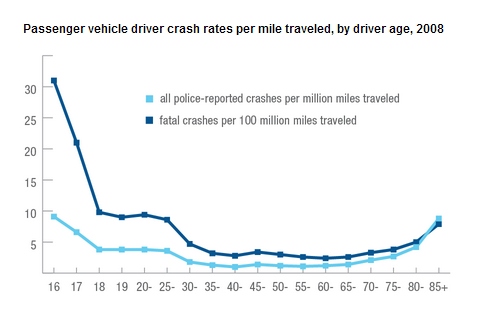
There are two periods where there are sharp declines: 19, and sometimes after 26, all the way to 35.
https://www.hallandalelaw.com/wp-content/uploads/2013/07/IIH...
If we assume, this is a indicator 'maturity', then the answer should be around 26-35, depending on the individual. It seems that the founding fathers were into something when the made the minimal age for a president at 35.
There is a reversal at 75+, but this is due to age related issues. And my experience from the older folks in my life, it seems people start reverting to a 'teenage' like state at 75+.
So i would say that you become adult when you have kids. Due to reasons this is postponed (or missing) to older and older age.
there is indivual agency, which can be found and practiced, and lost and forgoten
This may be an unpopular opinion but everyone needs to face a critical mass of unfortunate events at some part of their life. The earlier it happens the easier it is down the road.
For some this comes early, like a "child" looking after a sick parent. For others (like me) this comes with having children.
My wife and I look back on the years we thought we were adults, because we lived on our own, had jobs and a cat, and chuckle to ourselves at how grown up we thought we were. This type of pretending to be an adult we call "adulting".