FRESH Hacker News
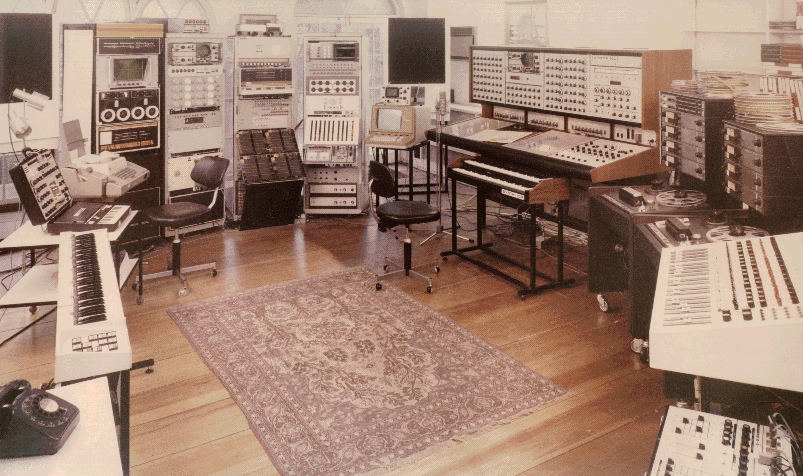
Hacker News Hacker NewsIt was supposedly the first computer sold to a private individual instead of business or academia. The purchaser was composer Peter Zinovieff, who used it in the electronic music studio he was building in his home. He paid for it by pawning his (aristocratic) wife's tiara. (They later divorced.)
Here it is in the racks at the back, next to a PDP-8/I which he bought later, and some of the synths and other products the company he created started selling soon after.
https://historyofinformation.com/images/Screen_Shot_2020-09-...
This was 1971. Computer control of analog synths, sampling, and video-to-sound with real time FFTs (from additional hardware) were years ahead of what Rest of World was doing then.
This effort was led by Tom Stockebrand, who had previously worked on a number of MIT Lincoln Labs and/or Wes Clarke machines, such as the LINC, which are celebrated for looking a bit like personal computers if you squint. (See Digital at Work, Jamie Parker Pearson ed., ISBN 0-13-213489-6 https://www.computerhistory.org/pdp-1/_media/pdf/dec.digital... pp. 90-1 :
> “One version was going to have a PDP-8 built into this slot in the back, along with a cassette tape drive that could be used like DECtape. The cost goal was $600. Even in 1971, that was dirt cheap for what would have been the first personal computer.”
Overall, this may have been one of the most important turning points in the history of the personal-computer market, and it's surely one of the biggest omissions from the usual telling of that story. The capabilities and form factor weren't all that new—the Datapoint 2200 and the Wang 2200 had already launched that decades, two bright red warning flares for the industry—but anything like a $600 price would have been quite something for the time.
> Barely a month after, the emergence of the IBM PC 5150 in August and its rapid sales sent a shockwave through the industry, causing Olsen to abruptly reconsider his negative opinion of the personal computer segment.
There's probably quite a lot of dramatic irony in this. I suspect that Digital's and Olsen's long-term ambition was usually for DEC to grab IBM's mainframe crown. That was probably the default long-term ambition for anyone in the computer business before the 1990s, but moreover the history of DEC—from Olsen coming out of his secondment from SAGE to IBM manufacturing muttering that he could do much better, to Gordon Bell's "VAX strategy" which aimed to put byte-addressed VAX-instruction-set machines in nearly every product category in a notably System 360ish way, to the decision to charge IBM's mainframe guns with the VAX 9000—mostly seems to suggest that that was the dream. To see IBM then tonk Digital and transform the whole industry with an IBM microcomputer must have set their heads spinning. Small consolation to them that it turned out to be the beginning of the end of IBM's dominance, too.
To give you a sense of scale, in 1963 when the first PDP8 was launched at $27k, here in the UK the very first JCB 3C backhoe loader was launched at around £2500 - roughly a quarter of the price of a PDP8 in real terms, or about three year's salary for its driver.
So think in terms of how much "You know what? It'd save us so much time and money to just buy ourselves one of *these* things" you could buy yourself with the money :-)