FRESH Hacker News
Hacker News Hacker NewsDo you have a background in homebuilding? Or have you ever built anything before?
Visualizing the design is one thing, but the feasibility must be considered -- and often vetted through engineer(s) -- from the initial design phase. And even then, despite the best planning attempts, inevitably there will be some issues that need to be addressed 'on-the-ground' during construction.
I think you may be onto something, and I believe LLM models could be capable of accounting for e.g. code restrictions, structural considerations, MEP conflicts, etc. Most of the 'knowledge' homebuilders accumulate is trainable and repeatable. And- at least in the US- most of it has been codified/standardized in the IRC. But still there are tons of little caveats & gotchas to consider. Maybe those details could be addressed directly in your system prompts?
Also curious: what kind of "other files" does Drafted export "for the rest of the pre-construction process"? IDK to what extent you've used any existing home design software, but Home Designer/Chief Architect are capable of creating a (detailed) BOM for the entire build, down to every member of framing lumber. If the user chooses to enter price information, they can also provide cost estimates. A seemingly obvious AI-assisted improvement would be gathering price data automatically- say from the Lowe's or similar Big Box Hardware nearest to the user's location. And ideally keeping it updated as lumber & other materials fluctuate in cost.
To me a really capable AI design software could also be capable of: - Basic electrical load calculations - HVAC/ Schedule D [ductwork] design - Structural considerations- e.g., recommending a joist plan: type/size/direction/spacing of floor joists + validating against IRC and/or joist manufacturer load tables - and a whole lot more
I have a number of other ideas in case you're interested. Feel free to send an email (in profile).
PS- are you familiar with BIM software (like AutoDesk Revvit)? There a lot of 3D modeling capabilities you could borrow that go way beyond floor plans and aesthetic architectural considerations.
How many of us have made house plans at some point?
That said, I think this is neat because I’m buying a condo and knowing what’s even possible (physically, allowed by code, etc) seems more art than science. Getting answers usually involves bringing someone on-site, and almost nothing can be DIY’d anymore (either due to permits, HOA, complexity, etc)
I've thrown some weird setups at it like a high bedroom:bathroom ratio and it's doing a great job at distributing bathroom access between the bedrooms, and arranging the bedrooms around shared spaces.
Thanks for sharing.
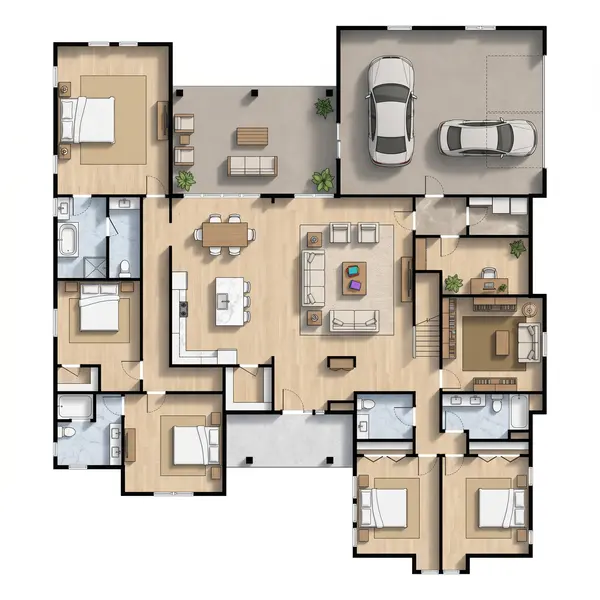
- A car parked in the garage perpendicular to the door and the other differently-sized car
- A bedroom missing a closet
- Attached bathrooms with multiple sinks
- An office with a weird entrance from a dead space from the garage
- External doors that open the wrong way (against fire code in most places)
- Closet doors opening inward
- Both doors of the top-left bathroom opens into the sinks (why two sinks?)
- The top-left bathroom has a weird dead space between the shower and bathtub (why both?)
- the random little floating feature in the middle of the open floorplan space doesn't make any structural or aesthetic sense
- The two bedrooms in the lower left with the weird bump-out for the windows that make no sense
- The window placement for many windows don't make sense and don't even line up with the 3D view of the house
- The hallway on the left that turns and goes to nowhere for no reason
- The additional random inaccessible dead spaces next to the bottom right bathroom
It took me just a few minutes to see this. I hope nobody ever builds a home based on these plans.
[1] https://cdn.drafted.ai/thumb/drafts/23025/generations/94729/...
Edited for formatting, to add a few points I missed, and to add a link to the image
looks great btw. congrats
We're building an ADU right now and the floorplan design was a very small part of what our architect did. So much more of the value came from the relationships he has with the structural and geotechnical engineers we used as well as the relationship with our city building department.
This really strikes me as a product in search of a problem.
Maybe a homeowner could use this for initial planning before finding an architect to use, but at that point you're competing with pencil and paper.
But if you're considering a pivot, interior design would be a great direction!
Given the space and furniture I have or could buy, what are my alternatives for flow and light and usability? What if energy or allergens are an issue?
This could engage users and has natural add-on's for buying things that would help monetize with price discrimination. End-users could be happy to explore, but you might have more features for designers.
You could fine-tune based on all the home-decorating videos and materials, add MCP for physical models (layout/positioning, environment), and use video models for ingesting current and visualizing results.
First thing that came to mind is that I would use this for a sim city style video game