FRESH Hacker News
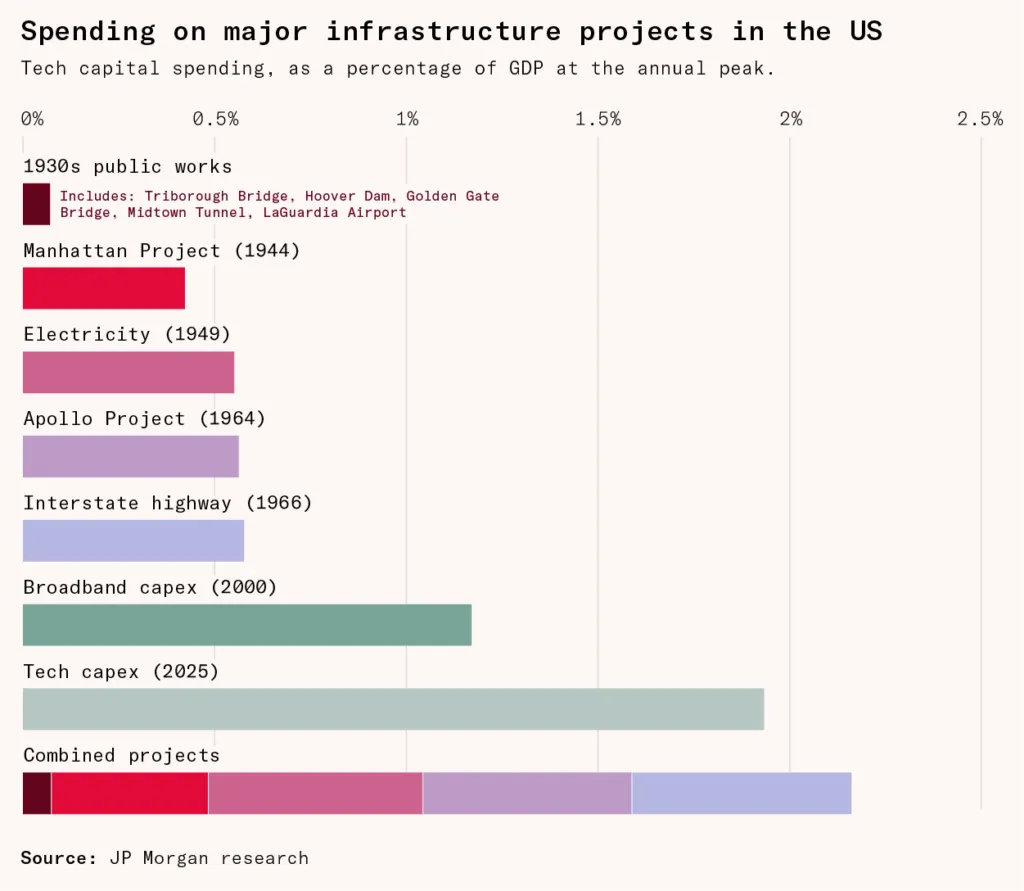
Hacker News Hacker NewsOf the items on this chart, I would say AI data centers are providing the least amount of value per % of GDP spent.
And 1930s public works the highest.
https://www.chevron.com/newsroom/2026/q2/chevron-signs-20-ye...
The idea is to bring the data centers, power generators and energy supply together in the ~same physical space so the only thing you have to transmit is data. Moving energy is way more expensive than moving information.
The bottleneck for building some AI datacentres and switching them on is electricity, sure, but that's not what drives growth. There also needs to be demand for the additional capacity; people need to be waiting for capacity to catch up so they can do the useful work that grows [society|GDP|something] that they aren't doing right now.
There's also very likely to be diminishing returns from additional capacity if we're near or over the limit of productive use. And there's the opportunity cost of what could have been done with that [money|land|electricity].
This is a much more complicated system than "people say they need more AI -> build datacenter -> power datacenter -> magical growth!"
2. Companies realising that they are burning half million to get nowhere
3. Circular investment scaring investors
4. And more recently, companies hiring people back coz the AI aimed to replace humans, created more problems than solved them
5. Memory cartel falling apart, again, they did the same thing during 2000s
6. China is making good ML free, supply and demand, destroying the US tech token business model
7. Even META has too much computer power and no enough use for them.
Those are the main reasons why AI buildout is not just slowing down but falling apart faster than expected.
And the reason current US policy opposes clean, renewable energy is --- purely political.
If the next order of magnitude costs 40B, I wonder if it’s even possible to get to the one after.
US administration can try to pull a China and basically remove all regulatory barriers (following existing playbook of "do whatever we want and wait a year or two for the courts to catch up and stop us"). It'll create havoc that will make people very upset (more so than the people that already protest DCs in their backyards). But even then, it's construction on varied terrain and property over long distances; you can't predict exactly how that will go. Triple the estimated timeline and that is probably doable, but current AI investment likely can't wait that long, unless somebody can pull additional hundreds of billions out of a hat to extend lines of credit or a ponzi-scheme-esque paying-creditors-with-newly-lent-money. In that time the market will realize the hype was hype, the gains were modest, they'll start divesting, and then the house comes down.
One way around that might be to deploy thousands more gas turbines and make rural air quality look like 2010 Beijing. It will probably happen if things get really tight, and we'll see how the current administrations's base responds; if they stick it out, the market gets a reprieve.
I really don't think this is the case. As far as I can tell there are two national security things where LLMs have some utility; mass surveilance (ick!!!) or software security. To me that does not justify a huge infrastructure buildout considering the implications of said infrastructure.
The real "AI" success story will be the person that makes an IRL backrooms theme park in the husk of a datacenter.
Or: laser tag park, the vests you wear are in part old tpu/gpu components.
We put the cart before the horse, lets stop talking about growth and focus on making it useful first lmao
https://en.wikipedia.org/wiki/GOELRO
"In 1920, British writer H. G. Wells visited Soviet Russia and met with Vladimir Lenin. Wells believed that it was impossible to realise the Russian revolutionary’s plan, as he wrote in his book Russia in the Shadows:
For Lenin, who like a good orthodox Marxist denounces all "Utopians," has succumbed at last to a Utopia, the Utopia of the electricians. He is throwing all his weight into a scheme for the development of great power stations in Russia to serve whole provinces with light, with transport, and industrial power..."
Our civilization is converging on electricity right now. 200 year ago electricity looked like a set of disparate phenomena. I wonder if in 200 years we'll be basing our society on some new energy form instead of electricity - something like gravitational conductors or some StarTrek singularity generators and plasma coils.
Fast forward 20 years from the advent of essentially infinite energy results in WWIII and a new “Great Detente” but only after all the assholes have wreaked all the havoc they can.
There are dark days ahead but ultimately a brighter future. Sucks to live through that transition phase though.